
How to Calculate Square Footage of a Room, a House or a Yard
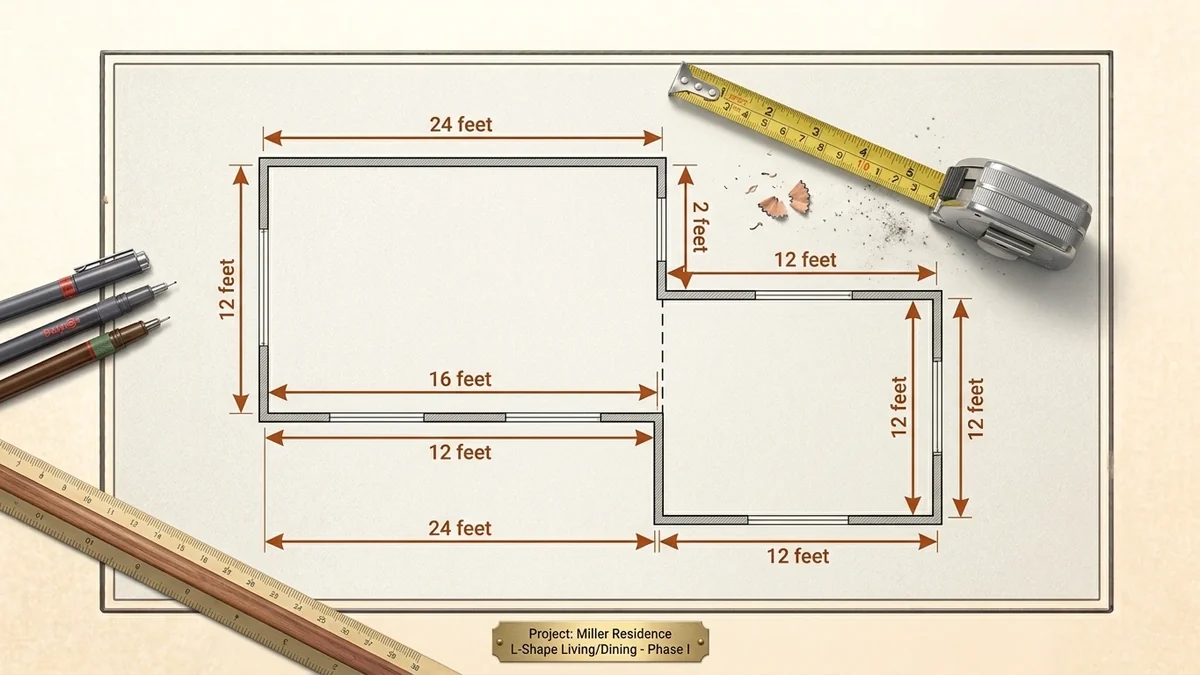
Square footage is the number nearly every other estimate depends on. Flooring, tile, paint, carpet, insulation and turf are all priced by coverage, so if the area is wrong, every quantity downstream is wrong by the same percentage. The formula takes five seconds. Measuring well takes a little more care, and knowing what to include takes more care still.
The basic formulas
Rectangle or square: length × width
Triangle: base × height ÷ 2 — where the height is the perpendicular distance to the base, not the length of a sloping side.
Circle: π × radius². If you measured the diameter, halve it first. A 10 ft circle is π × 5² = 78.5 sq ft, not 314.
L-shape or anything irregular: split it into rectangles, calculate each, and add them. Do not average the walls; averaging an L-shape gives a number that is confidently wrong.
The square footage calculator lets you add as many sections as you need and totals them, in whichever mix of units you measured in.
Measuring properly
- Measure at floor level, along the finished wall face, not at waist height where furniture and skirting get in the way.
- Work to the nearest inch, not the nearest foot. On a 12 × 14 ft room, rounding each dimension down by six inches loses 13 square feet — a full box of flooring.
- Measure both opposite walls. Rooms are rarely square. If they differ, use the larger dimension when ordering material and the smaller when checking whether something will fit.
- Add the alcoves and bays separately. A bay window is its own small rectangle or trapezoid, not a rounding error.
- Sketch as you go. A rough plan with dimensions written on it is worth far more than a list of numbers you have to reconstruct later.
For a whole house, measure room by room and add the totals, including hallways and closets. Do not measure the outside of the building and call it the interior floor area — exterior walls are typically 6 to 12 inches thick, and on a modest house that difference is easily 100 square feet.
Unit conversions
| From | To | Multiply by |
|---|---|---|
| Square feet | Square metres | 0.0929 |
| Square metres | Square feet | 10.764 |
| Square feet | Square yards | ÷ 9 |
| Square yards | Square feet | × 9 |
| Square feet | Acres | ÷ 43,560 |
| Acres | Hectares | × 0.4047 |
Which one you need depends on the trade. Carpet in North America is still often priced by the square yard. Tile and laminate are usually square feet or boxes. Almost everything outside North America is square metres. Land is acres or hectares.
The number people misremember most often is square metres: a square metre is 10.764 square feet, not 3.28. The 3.28 is the linear conversion, and squaring it is exactly where the error creeps in.
What to include, and what to leave out
This depends entirely on what you are buying.
For flooring: include every part of the floor being covered — under kickboards where the floor runs through, and closets if they are being floored. Exclude fixed islands and built-in cabinetry that sits directly on the subfloor. Then add 10% for cuts before ordering, which the flooring calculator does for you.
For paint: floor area is the wrong number entirely. You want wall area: perimeter × ceiling height, minus doors and windows. The paint calculator does that conversion from the room dimensions.
For a house listing or valuation: the rules are set by local convention and by measurement standards such as ANSI Z765 in the US, and they get specific about ceiling height minimums, stairs, and whether below-grade space counts. If the number is going on a listing or a valuation, use the standard that applies where you are rather than your own tape measure arithmetic.
For a yard or land: measure the boundary, split it into triangles and rectangles, and remember that 43,560 square feet is an acre. Sloping ground has more surface area than its plan area, which matters for turf and matters a lot for roofing.
Worked examples
A simple room: 12 ft 6 in × 10 ft 3 in. Convert the inches to decimals — 12.5 × 10.25 = 128.1 sq ft.
An L-shaped room: the main section is 14 × 10 ft and the extension is 6 × 8 ft. That is 140 + 48 = 188 sq ft. Splitting at the internal corner is the whole technique; everything else is addition.
A circular patio: 12 ft across. Radius 6, so π × 36 = 113.1 sq ft.
A room measured in metric: 3.6 m × 4.2 m = 15.12 m². Multiply by 10.764 = 162.8 sq ft.
Turning area into materials
Once the area is right, most other calculations are a division:
- Tile: area ÷ tile size, plus 10–15% for cuts.
- Flooring: area plus waste ÷ box coverage, rounded up to whole boxes.
- Carpet: area ÷ 9 for square yards, then checked against the roll width.
- Drywall: wall and ceiling area ÷ sheet area.
- Insulation: area ÷ the coverage on the pack.
- Anything with a depth — concrete, gravel, soil — is area × depth, and then the cubic yard calculator handles the volume.
Sloping and three-dimensional surfaces
Plan area and surface area are the same thing only on a flat floor. Anywhere the surface tilts, the real area is larger:
- Roofs. A 6/12 pitch adds 12% to the footprint, a 12/12 pitch adds over 41%. The roof pitch calculator gives the multiplier, and the roofing calculator applies it.
- Sloping lawns and banks. Turf and seed cover the actual surface, not the plan area shown on a drawing.
- Stairs. Carpet on a flight is measured per step — tread depth plus riser height plus a couple of inches — not from the footprint of the staircase.
- Textured walls. Heavy render or knockdown texture has more surface than its dimensions suggest, which is why paint coverage drops on it.
A quick sanity check
Before you order anything from an area figure, do one rough cross-check in your head. A typical bedroom is 120–180 sq ft. A single-car garage is around 240. A modest kitchen is 100–200. If your calculation comes out at 600 sq ft for a bedroom, you have multiplied inches by feet somewhere.
The same applies to conversions. Square metres should always be a much smaller number than square feet — roughly a tenth. If your metric figure is larger than your imperial one, the conversion has gone the wrong way.
Frequently asked questions
How do I calculate square footage?
Multiply length by width in feet. For irregular spaces, divide the area into rectangles, calculate each and add the results.
How do I find the square footage of an L-shaped room?
Split it into two rectangles at the internal corner. Calculate each separately and add them together. Do not try to average the dimensions.
How many square feet are in a square metre?
10.764 square feet. Going the other way, one square foot is 0.0929 square metres.
How many square feet are in a square yard?
Nine — a square yard is three feet by three feet. This is the conversion that matters when buying carpet.
Do closets count in square footage?
For material estimates, yes if you are covering the floor. For a property listing, it depends on the measurement standard that applies locally — check the standard rather than assuming.
How do I calculate the square footage of a circle?
Multiply π (3.1416) by the radius squared. If you measured across the full width, that is the diameter — halve it to get the radius first.
The habit worth forming
Measure the room once, carefully, and write the dimensions on a sketch. That single set of numbers then feeds the flooring order, the paint order, the tile order and the quote you compare them against. Almost every estimating error people make on a renovation traces back to measuring casually at the start and then trusting the number for weeks afterwards. The square footage calculator will keep the arithmetic honest; the tape measure is the part that is on you.