
How Much Paint Do I Need? Gallons Per Room, Worked Out
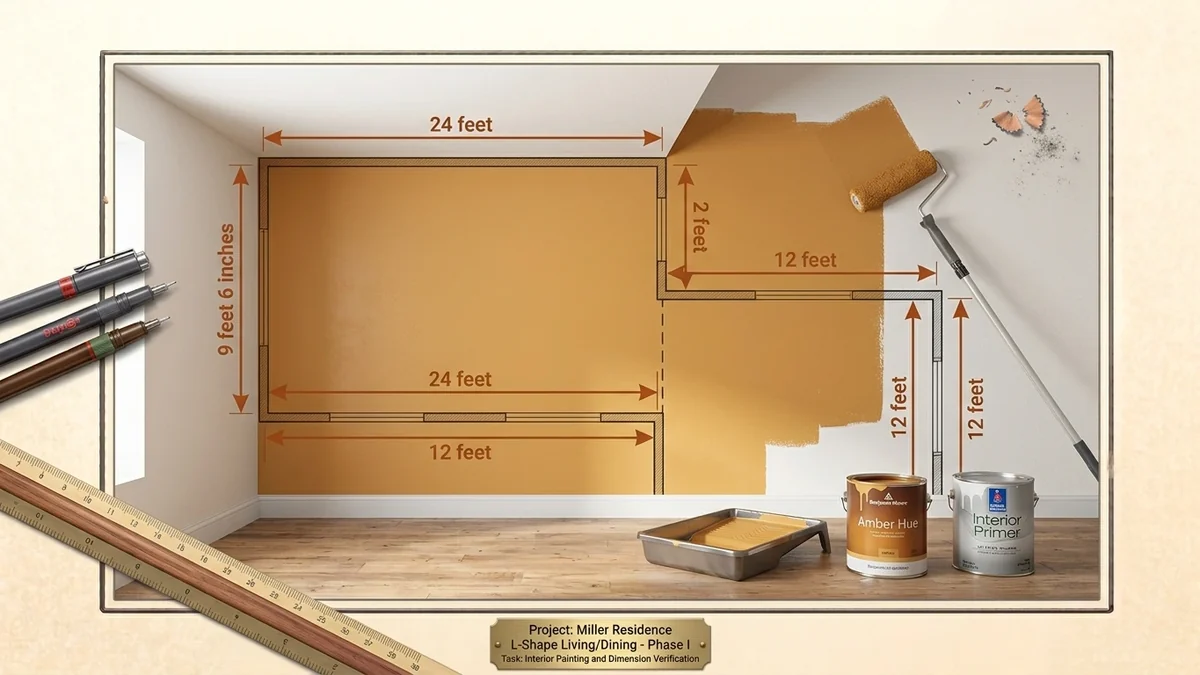
Paint is cheap to over-buy and expensive to run short on — not in money, but in the afternoon you lose driving back to the store and the risk that the new tin is a slightly different tint batch. The calculation is simple, but the coverage figure printed on the tin is optimistic often enough that it is worth understanding what actually changes it.
The wall area formula
Wall area = (length + width) × 2 × ceiling height
Then subtract the openings — roughly 20 square feet per standard door and 15 per average window — multiply by the number of coats, and divide by the coverage rate.
For a 12 × 12 ft room with 8 ft ceilings, one door and two windows:
- Perimeter: (12 + 12) × 2 = 48 ft
- Wall area: 48 × 8 = 384 sq ft
- Less one door (20) and two windows (30) = 334 sq ft
- Two coats: 668 sq ft
- At 350 sq ft per gallon: 1.9 gallons
So you buy two gallons. The paint calculator runs this from the room dimensions and lets you set the coverage rate from the tin you are actually buying, add the ceiling, and change the number of coats.
Common rooms at two coats
Wall area only, with typical openings deducted, at 350 sq ft per gallon and 8 ft ceilings:
| Room size | Wall area | Two coats | Buy |
|---|---|---|---|
| 8 × 10 ft | 253 sq ft | 506 sq ft | 1.5 gal |
| 10 × 12 ft | 302 sq ft | 604 sq ft | 2 gal |
| 12 × 12 ft | 334 sq ft | 668 sq ft | 2 gal |
| 12 × 16 ft | 398 sq ft | 796 sq ft | 2.5 gal |
| 15 × 20 ft | 510 sq ft | 1,020 sq ft | 3 gal |
Ceilings are separate and much smaller than people expect — a ceiling is just length × width. A 12 × 14 ft ceiling is 168 sq ft, comfortably under a gallon for two coats.
Coverage: why the tin is optimistic
The 350–400 sq ft per gallon figure assumes a smooth, sealed, previously painted wall in a similar colour. Several things reduce it, sometimes sharply:
- Bare drywall drinks the first coat. Expect noticeably less coverage unless you prime.
- Texture. Knockdown, orange peel or heavy render can cut coverage by a quarter to a third, because the actual surface area is larger than the flat dimensions suggest.
- Porous or chalky old paint absorbs more.
- Deep bases and strong colours. Reds, deep yellows and some strong blues have poor natural opacity — they can need three coats regardless of the surface.
- Spraying uses more paint than rolling for the same finish, because of overspray and the thinner, more numerous passes.
Read the coverage from the tin you are buying and then be slightly pessimistic about it.
How many coats?
Two is the standard answer, and it is the right one for most repaints.
Three, or two over a tinted primer, when you are going from dark to light, covering a strong colour, or painting over patched or stained areas. A tinted primer is almost always cheaper and quicker than a third coat of finish paint, and it gives a more even result.
One is realistic only when you are refreshing the same colour on a sound surface, and even then it often looks like one coat.
When to prime
Prime when the surface is new, repaired, stained, glossy, or dramatically different in colour from where you are going.
- New drywall needs a drywall primer (or PVA sealer) so the paper and the joint compound absorb at the same rate. Without it, every taped joint shows through as a different sheen — the effect known as flashing.
- Patches need spot priming for exactly the same reason.
- Glossy or previously oil-painted surfaces need a bonding primer, and usually a light sand first.
- Water stains, smoke or tannin-bleeding wood need a stain-blocking primer. Emulsion will not hold them back; the stain reappears within days.
Primer coverage is usually similar to paint, sometimes slightly less. Calculate it as its own coat.
Trim, doors and ceilings
- Trim and baseboards: a quart usually covers a normal room's trim for two coats. Measure the linear feet and assume a rough 6-inch width for a baseboard plus casing.
- Doors: about 20 sq ft per side. A quart does two or three doors.
- Ceilings: length × width, one coat if refreshing white on white, two if changing.
Finishes and where they go
- Flat / matte: hides wall imperfections best, cleans worst. Ceilings and low-traffic rooms.
- Eggshell / satin: the practical middle. Most walls, and the usual choice for hallways and kids' rooms because it wipes.
- Semi-gloss: trim, doors, kitchens and bathrooms. Durable and washable, shows every surface flaw.
- Gloss: furniture and small details. Very hard-wearing, very unforgiving.
Coverage is broadly similar across finishes; durability and how much the wall's flaws show are what actually differ.
Buying and storing
Round up to whole tins, and check the arithmetic on tin sizes before you do — a gallon plus a quart is frequently more expensive than two gallons, and the leftover from two gallons is useful for touch-ups. Buy all of one colour at once so the tint batch matches, or ask for the tins to be boxed together and mixed into one container before you start.
Write the colour name, code and base on the lid, not just on the receipt. Matching a colour from a dried drip three years later is a thoroughly miserable job.
Related estimates
If you are decorating a room properly, the paint is one of several numbers. Wallpaper works in whole drops rather than area, so it needs its own calculation. New or repaired walls need drywall, and the sheet count drives the compound and tape. And every one of these starts from the same square footage measurement.
Frequently asked questions
How much paint do I need for a 12x12 room?
With 8 ft ceilings, about 384 sq ft of wall before deductions — roughly one gallon per coat, so two gallons for two coats. Add a quart for the trim.
How much does a gallon of paint cover?
Around 350–400 square feet per coat on smooth, sealed walls. Textured, porous or bare surfaces cover considerably less.
How many coats of paint do I need?
Two for most repaints. Three, or two over a tinted primer, when covering a dark colour, a strong colour, or a patched wall.
How much paint do I need for a ceiling?
Ceiling area is simply length × width. A 12 × 14 ft ceiling is 168 sq ft — under half a gallon per coat.
Do I need to prime before painting?
Prime bare drywall, patches, stains, glossy surfaces and big colour changes. On a sound, previously painted wall in a similar colour, you can skip it.
How much paint for the trim in a room?
A quart generally covers the baseboards, casings and one door in an average room for two coats.
Before you start
Measure the room, deduct the openings, decide honestly whether the colour change needs two coats or three, and put the numbers into the paint calculator using the coverage from the tin in front of you. Then buy the whole job in one purchase. Almost every "the second tin looks slightly different" complaint traces back to buying paint twice.