
How Much Concrete Do I Need? A Straight Answer for Slabs, Footings and Posts
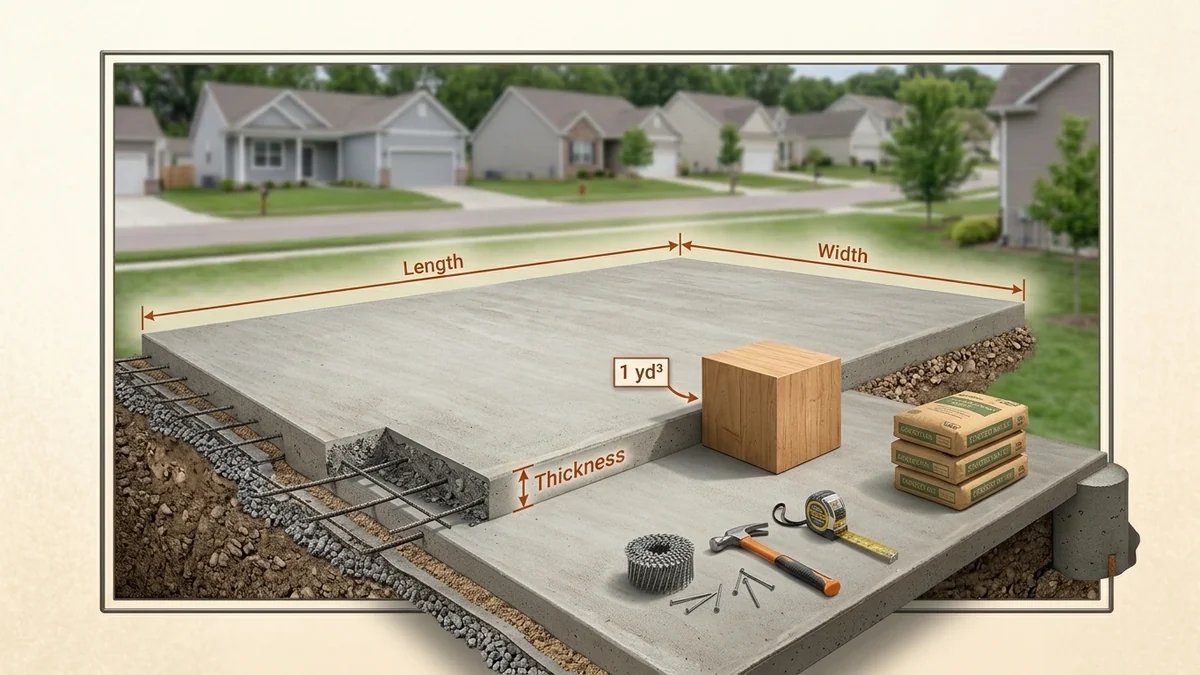
Concrete is the one material where running out halfway through is a genuine problem rather than an inconvenience. If a pour stops and the first half starts to set, you get a cold joint — a permanent weak line through the slab that no amount of finishing will hide. Add the surcharge most suppliers charge for a short second load, and the cost of guessing low is far higher than the cost of ordering a little extra.
The arithmetic itself is simple. What catches people out is the units, and there are three places to slip.
The formula, and the number 27
Concrete volume is area × thickness. That gives you cubic feet. To get cubic yards — the unit ready-mix is sold in — you divide by 27, not by 9. A cubic yard is three feet in every direction: 3 × 3 × 3 = 27 cubic feet.
The second trap is mixed units. Thickness is nearly always quoted in inches while length and width are in feet, so you have to convert the thickness before multiplying. Four inches is 0.333 feet, six inches is 0.5 feet.
Worked through for a 10 × 10 ft patio at 4 inches:
- 10 × 10 = 100 square feet
- 4 in ÷ 12 = 0.333 ft
- 100 × 0.333 = 33.3 cubic feet
- 33.3 ÷ 27 = 1.23 cubic yards
The concrete calculator does all of that from your dimensions, including circles and triangles, and adds a waste allowance. For a plain rectangular pour, the concrete slab calculator is the quicker route.
Common slab sizes at a glance
These are the theoretical volumes, before any waste allowance:
| Slab size | At 4 in thick | At 6 in thick |
|---|---|---|
| 8 × 8 ft | 0.79 cu yd | 1.19 cu yd |
| 10 × 10 ft | 1.23 cu yd | 1.85 cu yd |
| 12 × 12 ft | 1.78 cu yd | 2.67 cu yd |
| 12 × 20 ft (single drive) | 2.96 cu yd | 4.44 cu yd |
| 20 × 20 ft (double garage) | 4.94 cu yd | 7.41 cu yd |
| 24 × 24 ft | 7.11 cu yd | 10.67 cu yd |
Notice how much the thickness moves the total. Going from 4 to 6 inches adds 50% to the order — which is why "we may as well make it a bit thicker" is a decision worth pricing before you make it.
Bags or ready-mix?
A standard 80 lb bag of concrete mix yields about 0.6 cubic feet. That means:
- 80 lb bags: 45 per cubic yard
- 60 lb bags: 60 per cubic yard
- 40 lb bags: 90 per cubic yard
Forty-five bags is 3,600 lb of material to carry, open and mix, and mixing that much by hand in one session while keeping a consistent water ratio is genuinely hard work. As a rough guide:
- Under 0.5 cubic yards — bags are comfortable. A couple of dozen at most.
- 0.5 to 1 cubic yard — bags are possible with a mixer and a helper, but it is a full day.
- Over 1 cubic yard — ready-mix is usually cheaper once you count your own time, and it gives you a consistent mix from a single batch.
Most ready-mix suppliers have a minimum order (often 1 cubic yard) and a short-load fee below a certain volume, so it is worth asking about both before you decide. Trucks typically hold up to 10 cubic yards.
How thick should the slab be?
For non-structural residential work, the usual figures are:
- Patios, walkways, shed bases: 4 inches
- Driveways for cars: 4 inches over a compacted base
- Driveways taking a truck or RV: 5–6 inches
- Garage floors: 4–6 inches
Two important caveats. First, the base matters more than the extra inch of concrete: 4 inches over a well-compacted 4-inch gravel base outperforms 6 inches poured on soft ground. Second, anything structural — footings, suspended slabs, load-bearing pads, anything supporting a building — is not a thickness you pick from a table. Your local building code sets those figures, and for anything unusual you need an engineer.
Footings and post holes
Footings are just long rectangular prisms: length × width × depth. A 40 ft run of 16 in × 8 in footing is 40 × 1.333 × 0.667 = 35.6 cubic feet, or 1.32 cubic yards. The footing calculator handles it, but the dimensions themselves have to come from your code and your soil conditions — frost depth in particular varies enormously by region, and a footing above the frost line will heave.
Post holes are cylinders, minus the volume the post itself occupies. For the common case — a 4×4 post in a 10 in hole, 30 in deep:
- Hole: π × (5 in)² × 30 in = 2,356 cu in = 1.36 cu ft
- Post: 3.5 × 3.5 × 30 = 368 cu in = 0.21 cu ft (a "4×4" actually measures 3.5 in)
- Concrete: about 1.15 cubic feet, or roughly two 80 lb bags
The post hole concrete calculator does this for any number of posts at once. Put 4–6 inches of gravel in the bottom of each hole for drainage, and crown the concrete above grade so water runs away from the post rather than sitting against it.
How much extra should you order?
Between 5% and 10% for most jobs. That allowance is not padding — it covers real losses:
- Subgrade that dips even slightly. A half-inch average dip across a 20 × 20 ft slab is an extra 0.6 cubic yards.
- Forms that bow outward under the weight of wet concrete.
- Concrete left in the chute, the wheelbarrow and on the ground.
- Over-excavation at the edges.
Five percent is reasonable on a well-prepared, laser-levelled base. Ten percent is sensible on rough ground or where you excavated by hand. If the calculator says 3.2 cubic yards, order 3.5. The extra concrete costs a fraction of what a second truck costs.
Reinforcement
Most slabs get either welded wire mesh or a rebar grid. For a rebar grid, count bars in both directions and remember that where bars are spliced they must overlap — the lap length is specified by code and is often around 40 bar diameters. The rebar calculator counts bars, laps and tie intersections from your slab size and spacing, but the bar size, spacing and lap length are all engineering decisions that belong to your code or your engineer.
Frequently asked questions
How much concrete do I need for a 10x10 slab?
A 10 × 10 ft slab at 4 inches thick needs 1.23 cubic yards, which is about 56 of the 80 lb bags. Add 5–10% for waste, so order around 1.35 cubic yards or 60 bags.
How many bags of concrete are in a cubic yard?
About 45 of the 80 lb bags, 60 of the 60 lb bags, or 90 of the 40 lb bags. Each 80 lb bag yields roughly 0.6 cubic feet, and a cubic yard is 27 cubic feet.
How much does a cubic yard of concrete weigh?
Around 4,000 lb, or two US tons, at a typical density of 145 lb per cubic foot. That is worth knowing if you are moving it by wheelbarrow — one yard is about 25 heaped barrow loads.
How thick should a concrete driveway be?
Four inches over a compacted base is standard for cars. Five to six inches if a truck, RV or delivery vehicle will park on it. The base preparation matters at least as much as the thickness.
Can I pour concrete in stages?
For a slab, not really — you want a single continuous pour so it cures as one piece. If you must split it, plan a proper construction joint with dowels rather than simply stopping mid-slab. Separate elements such as individual footings or post holes are fine to do on different days.
How long before I can walk on it?
Typically 24–48 hours for foot traffic and about seven days before driving on it, though concrete keeps gaining strength for weeks and cold weather slows everything down. Follow the supplier's guidance for the mix you used.
Before you order
Measure twice, run the numbers through the concrete calculator, add your waste allowance, and round up to the nearest quarter yard if you are ordering ready-mix. Then check the one thing the calculator cannot tell you: whether the thickness, reinforcement and footing depth you have chosen are the ones your local building department expects. Quantities are arithmetic; specifications are code.