
How Much Mulch Do I Need? Bags, Cubic Yards and the Right Depth
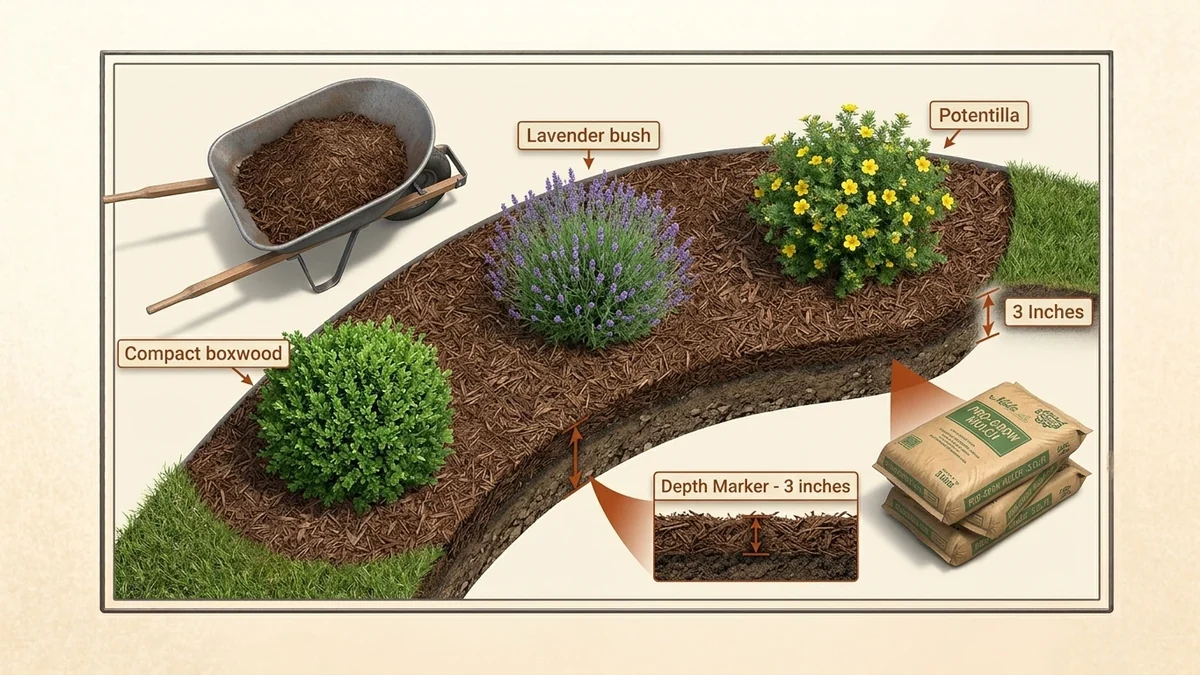
Mulch is the material most often over-ordered and, oddly, most often applied too deep. Both mistakes come from the same place: it is sold in small bags that make the quantity feel larger than it is, and it looks better fresh, so people keep going. Getting the depth right saves money and is better for the plants.
The formula
Same as any bulk material:
Area (sq ft) × depth (ft) ÷ 27 = cubic yards
A 200 sq ft bed at 3 inches deep:
- 3 ÷ 12 = 0.25 ft
- 200 × 0.25 = 50 cubic feet
- 50 ÷ 27 = 1.85 cubic yards
The mulch calculator handles rectangles, circles and triangles, and converts straight into bags at whatever bag size you are buying.
How deep should mulch be?
Two to three inches. That is the answer for almost every bed.
Deeper is not better, and this is one of the few places where the conventional wisdom is also the correct wisdom:
- Mulch piled deep holds water against stems and trunks, which invites rot and gives pests a place to live.
- A thick layer can shed light rain rather than letting it through, so the soil underneath actually gets drier.
- Roots need air. A deep, matted layer of fine mulch restricts gas exchange.
The classic bad example is the "mulch volcano" piled against a tree trunk. Mulch should stop three to six inches short of the trunk, forming a flat ring rather than a cone. Around perennials and shrubs, keep it clear of the stems for the same reason.
Where you can go deeper: paths, and areas where you are actively trying to smother weeds — 4 inches there is reasonable, and coarser material holds its structure better.
Coverage: what a cubic yard does
| Depth | Coverage per cubic yard |
|---|---|
| 1 in | 324 sq ft |
| 2 in | 162 sq ft |
| 3 in | 108 sq ft |
| 4 in | 81 sq ft |
In bags, at the common 2 cubic foot size, 13.5 bags make a cubic yard. At 3 cubic feet, it takes 9 bags.
That number is the whole bags-versus-bulk decision. Thirteen and a half bags per yard means:
- Under 1 cubic yard (roughly 100 sq ft at 3 in): bags are fine, and you can carry them in a car.
- 1 to 3 cubic yards: bulk is usually cheaper per unit, but factor in delivery and the fact that a pile in the driveway has to be moved by wheelbarrow.
- Over 3 cubic yards: bulk almost always wins on price, often by a wide margin.
Bags have real advantages beyond price: they store, they do not blow around before you spread them, and you can buy exactly as many as you need. Bulk is cheaper but it arrives all at once and it is your problem until it is spread.
Weight and delivery
Mulch is light — roughly 0.35 to 0.5 US tons per cubic yard dry, compared with 1.4 tons for gravel — because it is mostly air. Wet mulch is considerably heavier, which matters if you are having it delivered by weight or moving it by hand after rain. A cubic yard of dry mulch is around 20 wheelbarrow loads.
Choosing a mulch
- Shredded hardwood: knits together and stays put on slopes. The general-purpose choice.
- Bark nuggets: last longer, but float and wash away in heavy rain or on any slope.
- Pine straw: light, easy to spread, good on slopes, acidifies the soil slightly as it breaks down.
- Wood chips (arborist chips): often free from tree services. Coarse and variable, excellent for paths and around trees, less tidy in a front bed.
- Compost: feeds the soil rather than just covering it, but breaks down fast and can grow weeds from seed in the mix.
- Rubber and stone: do not break down, so they never need topping up — but they also add nothing to the soil, and stone reflects heat onto plants.
Dyed mulches are dyed with colourants that are generally considered safe for garden use; the more relevant question is what the underlying wood is, since some dyed products are made from recycled construction timber.
When to top up
Organic mulch breaks down — that is the point of it — so beds typically need refreshing every year or two. Rather than adding a full 3 inches each time, measure what is left and top up to 3 inches. Otherwise the layer creeps deeper season after season, and after four years you have a 6-inch mat that is doing more harm than good. Fluffing up the existing layer with a rake often improves the appearance enough that a top-up is not needed at all.
What goes underneath
Landscape fabric under mulch is more contested than it looks. It does suppress weeds initially, but weed seeds germinate happily in the mulch above it, and it makes future planting and soil improvement awkward. In perennial beds, most gardeners now skip it and rely on mulch depth alone. Under permanent decorative stone, where nothing will be planted, it is more clearly useful.
If you are also building up the bed, calculate the topsoil separately — soil goes under, mulch goes on top, and adding them together in one number gets you the wrong quantity of both.
Working out an odd-shaped bed
Most beds are not rectangles. Three approaches, in order of how much effort they take:
- Split it into rectangles and triangles. A curved border can usually be approximated well enough by two or three shapes. Add the areas.
- Treat a rough circle as a circle. Measure across the widest point, halve it for the radius, and use π × r². A 12 ft round bed is 113 sq ft.
- Pace the perimeter and estimate. For a long ribbon bed, multiply the average width by the length. A border 3 ft wide and 40 ft long is 120 sq ft, and averaging the width is perfectly adequate at this level of precision.
The mulch calculator takes rectangles, circles and triangles directly, and the square footage calculator will total several sections if you want the area on its own for other purposes.
Cost, in practice
The price gap between bagged and bulk is usually larger than people expect once you convert to the same unit. If bagged mulch is around $4 for a 2 cu ft bag, that is roughly $54 per cubic yard before you have moved anything. Bulk delivered is frequently a fraction of that, though delivery is often charged as a flat fee that only makes sense above a certain volume.
The break-even is therefore not a fixed number of yards — it depends entirely on the delivery charge. Work it out for your own supplier: divide the delivery fee by the price difference per yard, and that is the number of yards at which bulk starts to win.
One practical note on bulk: a cubic yard occupies roughly a 3 ft cube, but tipped loose on a driveway it spreads to about 5 ft across and 3 ft high. Three yards is a substantial pile and it needs somewhere to sit that is not blocking a car. Have the tarp down before the truck arrives.
Frequently asked questions
How many bags of mulch are in a cubic yard?
13.5 bags at 2 cubic feet each, 9 bags at 3 cubic feet, or 18 bags at 1.5 cubic feet.
How much does a yard of mulch cover?
108 square feet at 3 inches deep, or 162 square feet at 2 inches.
How deep should mulch be around a tree?
Two to three inches, spread in a flat ring out towards the drip line, and kept three to six inches clear of the trunk itself. Piling mulch against the bark traps moisture and can kill the tree slowly.
Is it better to buy mulch in bags or bulk?
Bulk is cheaper beyond about a cubic yard, which is roughly 13 or 14 bags. Below that, bags usually win once you account for delivery charges and the effort of moving a pile.
How often should mulch be replaced?
Organic mulch typically needs topping up annually. Rather than adding a full layer, measure what remains and add only enough to bring it back to 2–3 inches.
Does mulch attract termites?
Mulch does not attract termites in the way the folklore suggests, but any damp wood against a house foundation is not a good idea. Keep mulch a few inches clear of siding and foundation walls, and use a shallower layer near the house.
Before you buy
Measure the beds, decide on 2 or 3 inches deliberately, and put the numbers into the mulch calculator — it will give you cubic yards and a bag count side by side, which is exactly the comparison you need to decide between a delivery and a car full of bags. Then measure what is already on the bed before you order: most gardens need less than the owner expects.