
How Much Gravel Do I Need? Tons, Cubic Yards and the Right Depth
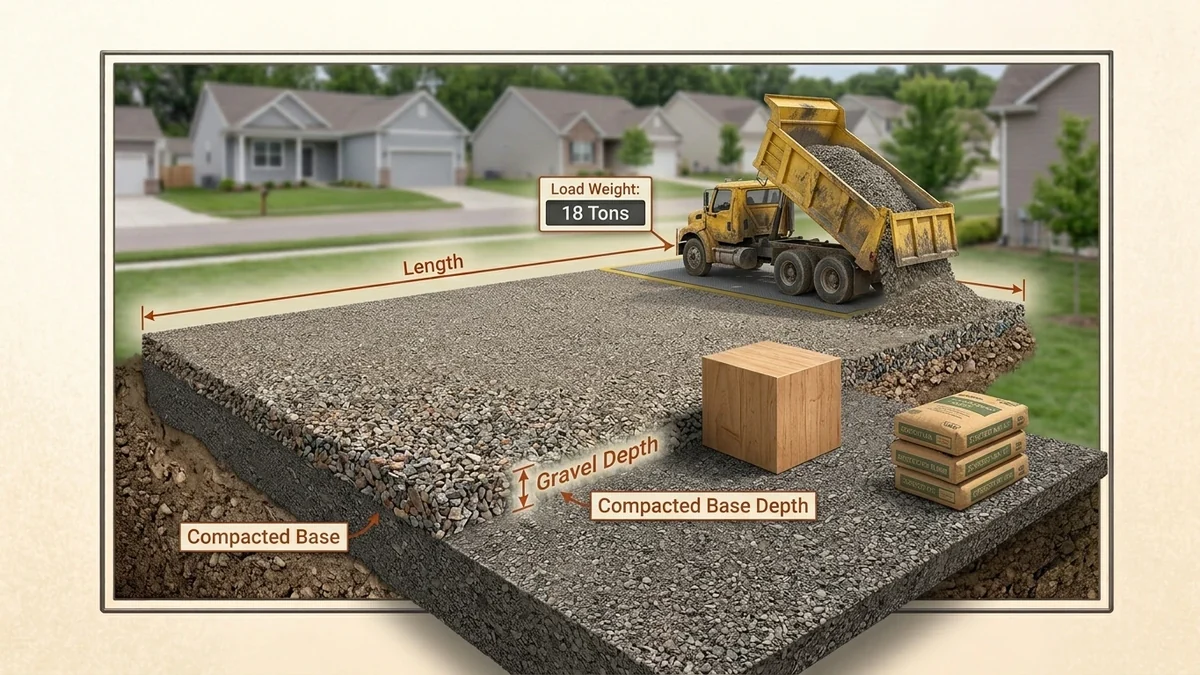
Gravel is sold two different ways, sometimes by the same supplier in the same phone call: by the cubic yard (a volume) and by the ton (a weight). Compare a quote in one unit against a quote in the other and you can easily be out by a factor of two. So the useful answer to "how much gravel do I need" is actually two numbers, and the conversion between them depends on the stone.
Start with volume
The formula is the same as for any bulk material:
Area (sq ft) × depth (ft) ÷ 27 = cubic yards
The two mistakes are dividing by 9 instead of 27, and forgetting that depth is usually given in inches. A 20 × 10 ft path at 3 inches deep:
- 20 × 10 = 200 sq ft
- 3 ÷ 12 = 0.25 ft
- 200 × 0.25 = 50 cubic feet
- 50 ÷ 27 = 1.85 cubic yards
The gravel calculator does this for rectangles, circles, triangles or a known area, and gives you the weight alongside the volume. For a pure volume conversion with no material assumptions, the cubic yard calculator is the general-purpose version.
Converting to tons
A cubic yard of gravel weighs roughly 1.4 US tons — around 2,800 lb — but the real figure moves with the stone size, how angular it is, and how wet it is. Typical densities:
| Material | lb per cubic foot | Tons per cubic yard |
|---|---|---|
| Pea gravel | 100–105 | 1.35–1.4 |
| Crushed stone (¾ in) | 100–110 | 1.35–1.5 |
| Crusher run / road base | 115–135 | 1.55–1.8 |
| Sand | 95–110 | 1.3–1.5 |
| Topsoil | 90–100 | 1.2–1.35 |
| Mulch | 20–30 | 0.27–0.4 |
Crusher run is heavier than clean stone because the fines fill the gaps between the larger pieces — that is also exactly why it compacts well and makes a better base. If you are ordering a large quantity, ask the supplier for their density figure rather than using a table.
Coverage: what one cubic yard actually does
Working backwards is often more useful than working forwards. One cubic yard, spread evenly:
| Depth | Coverage |
|---|---|
| 1 in | 324 sq ft |
| 2 in | 162 sq ft |
| 3 in | 108 sq ft |
| 4 in | 81 sq ft |
| 6 in | 54 sq ft |
By weight, at 1.4 tons per yard, one ton of gravel covers about 116 sq ft at 2 inches or 77 sq ft at 3 inches.
How deep should gravel be?
Depth drives cost directly — double the depth and you double the order — so it is worth being deliberate rather than generous.
- Decorative gravel over landscape fabric: 2–3 inches. Deeper looks the same and costs more.
- Garden path, foot traffic only: 2–3 inches over a compacted subgrade.
- Gravel driveway: 4–6 inches total, and ideally in two layers — a coarser base of 2–3 inch stone topped with a compacted layer of ¾ inch crusher run.
- French drain / drainage bed: 4–12 inches of clean, washed stone depending on the design. Clean stone here, not crusher run — the fines that make crusher run compact are the same fines that clog a drain.
- Paver or slab base: typically 4 inches for a patio and 6–8 inches for a driveway, compacted in 2-inch lifts.
Stone sizes and what they are for
- Pea gravel (⅜ in, rounded): comfortable underfoot, good for paths and around pools, but it migrates because the rounded stones roll. It needs edging.
- ¾ in crushed stone: the general-purpose angular stone. Locks together, drains well, good for driveway surfaces and drainage.
- Crusher run (¾ in minus with fines): the base material. Compacts to a firm surface. Poor drainage by design.
- #57 stone: clean, washed, no fines. The usual choice for drainage layers and septic fields.
- Larger rip-rap and cobbles: erosion control and decorative features rather than surfaces.
For a driveway the usual mistake is putting a decorative surface stone straight onto soil. Without a compacted base the stone works down into the ground and disappears — you end up buying it twice.
Compaction and the extra you should order
Gravel delivered loose settles when it is spread and compacted, typically losing 10–20% of its loose volume. That is why the calculator defaults to a waste allowance and why ordering the exact theoretical figure usually leaves you slightly short.
Beyond compaction, allow for:
- Spreading losses at the edges of the area.
- Uneven subgrade that swallows more than the nominal depth.
- A little extra to top up in a year — gravel surfaces need refreshing.
Five to ten percent on a well-prepared area, more on rough ground.
Related materials
The same volume arithmetic covers a lot of ground once you have it. Sand for a paver bed, topsoil for a new lawn, mulch for beds and asphalt for a drive all come down to area × depth, with a different density each time. If you are building a patio, the paver calculator also returns the base gravel and bedding sand alongside the paver count.
Frequently asked questions
How many tons of gravel are in a cubic yard?
About 1.4 US tons for typical driveway gravel, though it ranges from roughly 1.2 tons for light pea gravel to 1.8 tons for dense crusher run. Ask your supplier for the density of the specific product.
How much area does a ton of gravel cover?
At 2 inches deep, roughly 116 square feet. At 3 inches, about 77 square feet. At 4 inches, around 58 square feet.
How deep should a gravel driveway be?
Four to six inches of total gravel over a compacted subgrade, ideally built as a coarse base layer with a finer compacted surface layer on top. On soft or clay soils, use a geotextile fabric under the base — it stops the stone migrating down into the soil.
How much gravel do I need for a 20x20 patio base?
A 20 × 20 ft area at 4 inches deep is 400 × 0.333 = 133 cubic feet, or 4.94 cubic yards — about 7 tons. Add 10% for compaction and spreading.
Should I put fabric under gravel?
Under a driveway or a load-bearing base, yes — a woven geotextile stops the stone sinking into the soil and dramatically extends the life of the surface. Under decorative gravel, a landscape fabric mainly suppresses weeds; it helps, but weeds will eventually root in the debris that collects on top of it.
Is gravel cheaper by the ton or by the yard?
Neither, once you convert properly — it is the same material. Suppliers simply price the way their scales or their trucks work. Convert both quotes to the same unit before comparing, which is exactly what the calculator's two figures are for.
Before you order
Measure the area, decide the finished depth deliberately rather than by feel, run it through the gravel calculator, and add 10% for compaction. Then ask the supplier two questions: what their material weighs per cubic yard, and what the delivery charge is. On a small job the delivery is often a larger part of the bill than the stone, which usually means one properly sized order beats two cautious ones.