
Interior & Finishing Calculators
Measure a room once and get everything you need to buy it out: square footage, paint by the gallon or litre, tile and flooring by the box, drywall sheets, insulation rolls and wallpaper rolls — with a cut allowance built in.
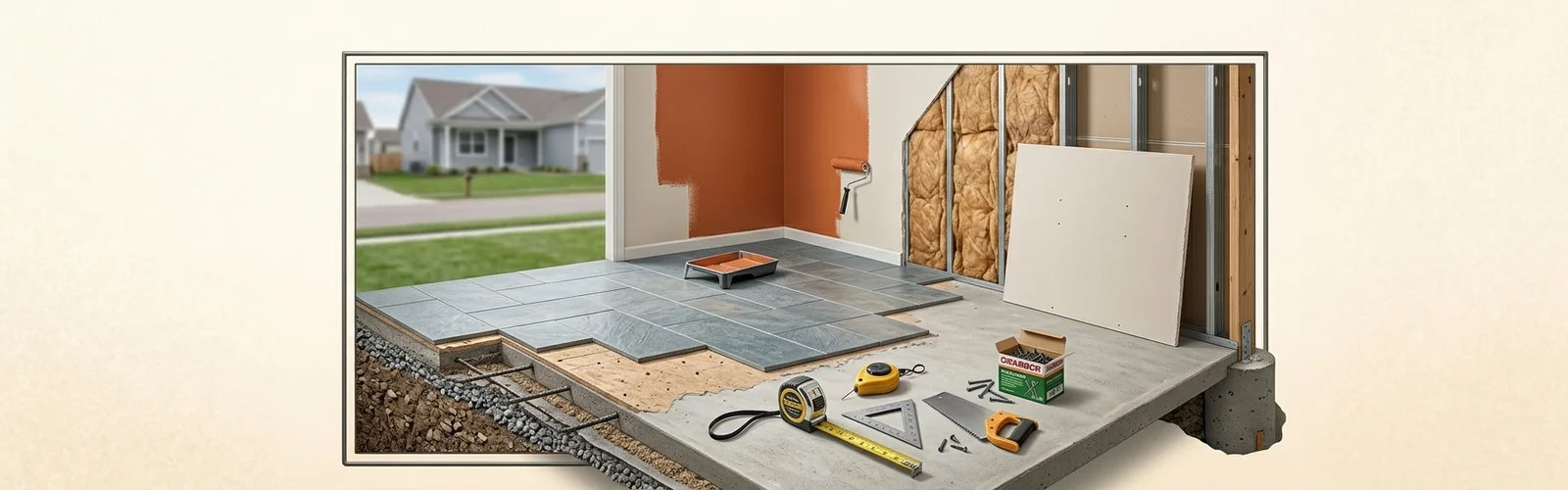
Choose a calculator
Square Footage Calculator
Free square footage calculator: add rectangles, circles and triangles to get total area in sq ft, sq m and sq yd.
Paint Calculator
Free paint calculator: enter room size, coats, doors and windows and get gallons or litres needed for walls, ceiling and trim.
Tile Calculator
Free tile calculator: enter the area and tile size to get tiles needed, boxes to buy, grout and adhesive, with a cut allowance.
Flooring Calculator
Free flooring calculator: enter room size and box coverage to get square footage, boxes needed, underlay and cost.
Carpet Calculator
Free carpet calculator: get square feet, square yards and square metres for a room, plus underlay and cost.
Drywall Calculator
Free drywall calculator: get sheets of plasterboard, screws, joint tape and compound from your wall and ceiling dimensions.
Wallpaper Calculator
Free wallpaper calculator: get the number of rolls from room size, roll dimensions and pattern repeat.
Insulation Calculator
Free insulation calculator: get batts, rolls or bags of blown-in insulation for walls, floors and attics from your dimensions, stud spacing and R-value.
Why square footage comes first
Almost every interior material is sold by coverage, so the room's area is the number that drives all of it. Get it right once and paint, flooring, tile and underlay all fall out of it. The common mistakes are measuring the outside of the room instead of the finished inside face, forgetting alcoves and bay windows, and rounding each wall down. Measure to the nearest inch, add the sections separately rather than averaging, and let the calculator do the conversion.
Waste allowances are not padding
Every material here is cut to fit, and the offcuts are rarely reusable. Ten percent is the normal allowance for tile and flooring in a simple rectangular room; fifteen for diagonal or herringbone layouts, and for rooms with lots of jogs, doorways and islands. Plank flooring also needs enough spare for the first and last row to be a sensible width. Buying from the same batch matters too — tile and laminate shade varies between production runs, so a top-up box bought three weeks later may not match.
Frequently asked questions
How do I calculate square footage of a room?
Multiply length by width in feet. For L-shaped rooms, split the space into rectangles, work each one out and add them together — the calculator above lets you add sections.
How much extra flooring or tile should I buy?
Ten percent for a straight layout, fifteen percent for diagonal or herringbone patterns and for rooms with many cuts. Buy it all in one order so the batch matches.
Do I subtract doors and windows?
For paint, yes — the calculators deduct them. For flooring, only if the opening reaches the floor. For drywall, deduct large openings but not small ones, because offcuts around them are rarely usable.
Are these calculators free?
Yes. No account, no limits, and every calculation runs in your browser — nothing you type is sent anywhere.
Do they work in metric?
Yes. Each dimension has its own unit selector, and results are given in both imperial and metric.