
Landscaping & Outdoor Calculators
Estimate bulk materials for driveways, beds, patios and yards. Enter the area and depth and get cubic yards, tons, bag counts and an optional cost — with shape options for rectangles, circles and triangles.
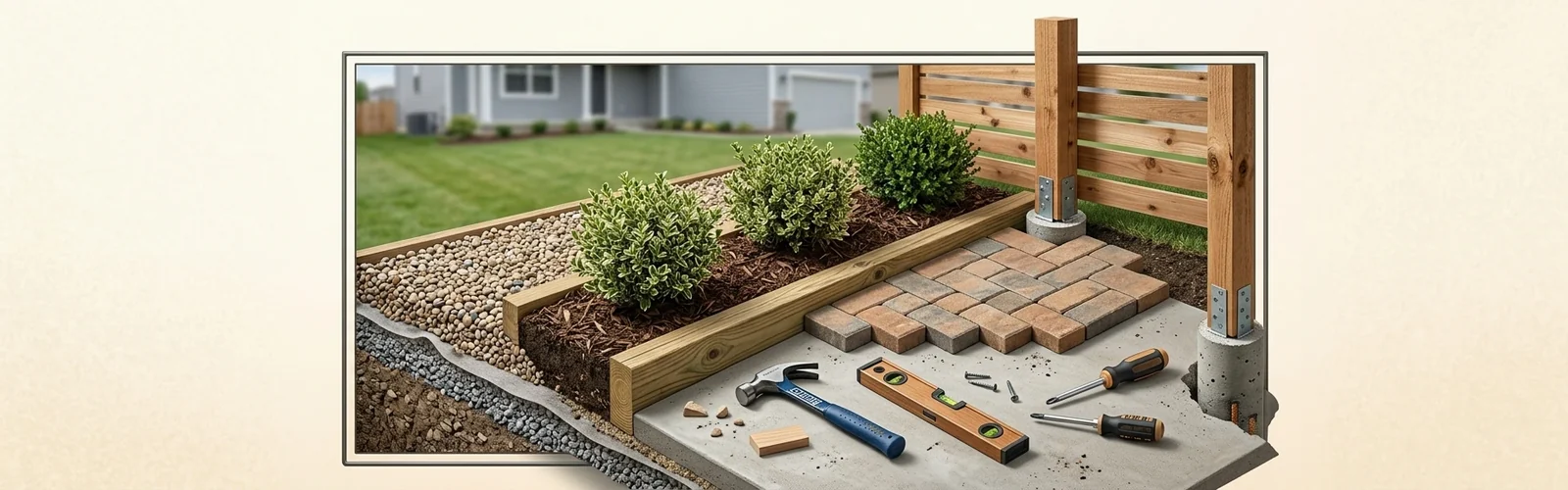
Choose a calculator
Gravel Calculator
Free gravel calculator: enter area and depth to get cubic yards, tons and cost for driveways, paths and drainage.
Mulch Calculator
Free mulch calculator: enter bed size and depth to get cubic yards and how many bags of mulch you need.
Fence Calculator
Free fence calculator: work out posts, sections, rails, pickets and concrete from your fence length, post spacing and height.
Topsoil Calculator
Free topsoil calculator: work out how much soil you need for lawns, beds and raised beds in cubic yards, bags and tons.
Sand Calculator
Free sand calculator for paver bases, sandboxes, pool bases and bedding layers.
Asphalt Calculator
Free asphalt calculator: get tons, cubic yards and cost for a driveway or parking area from the dimensions and compacted thickness.
Retaining Wall Calculator
Free retaining wall calculator: work out blocks per course, total blocks, base gravel and drainage stone from your wall length and height.
Paver Calculator
Free paver calculator: how many pavers you need plus base gravel, bedding sand and edge restraint for a patio, walkway or driveway.
Ordering bulk material by volume or by weight
Landscape suppliers sell gravel and stone by the ton but mulch and soil by the cubic yard, which makes comparing quotes awkward. The conversion depends on density: a cubic yard of gravel weighs roughly 1.4 tons, topsoil about 1.35 tons, and mulch only around 0.35 tons because it is mostly air. Our calculators show volume and weight together so you can order in whichever unit the supplier uses.
Getting the depth right
Depth matters more than people expect, because volume scales directly with it. Mulch is usually 2–3 inches — deeper suffocates roots and invites rot at the stem. Decorative gravel is 2–3 inches; a gravel driveway needs 4–6 inches over a compacted base. Topsoil for a new lawn is 4–6 inches, and for beds 8–12 inches. Doubling the depth doubles the cost, so it is worth checking before ordering.
Frequently asked questions
How many cubic yards do I need?
Multiply the area in square feet by the depth in feet, then divide by 27. Enter your measurements above and the calculator handles the conversion.
How much does a cubic yard of gravel weigh?
Roughly 1.4 US tons (2,800 lb), though it varies from about 1.2 to 1.7 tons depending on stone size and moisture.
How deep should mulch be?
Two to three inches. Deeper holds too much moisture against plant stems and can starve roots of air. Keep it pulled back from trunks.
How much does a cubic yard cover?
At 2 inches deep, one cubic yard covers about 162 square feet. At 3 inches, about 108 square feet. At 4 inches, roughly 81 square feet.
Can I calculate a circular or triangular area?
Yes. Every landscaping calculator lets you choose rectangle, circle, triangle, or enter a known area directly.